
A stick-pack machine selected for one client’s powder may leave the next client’s order outside the qualified process. Build a client-to-configuration record before choosing lane count, and use a pilot to connect dosing, material handling and batch release.
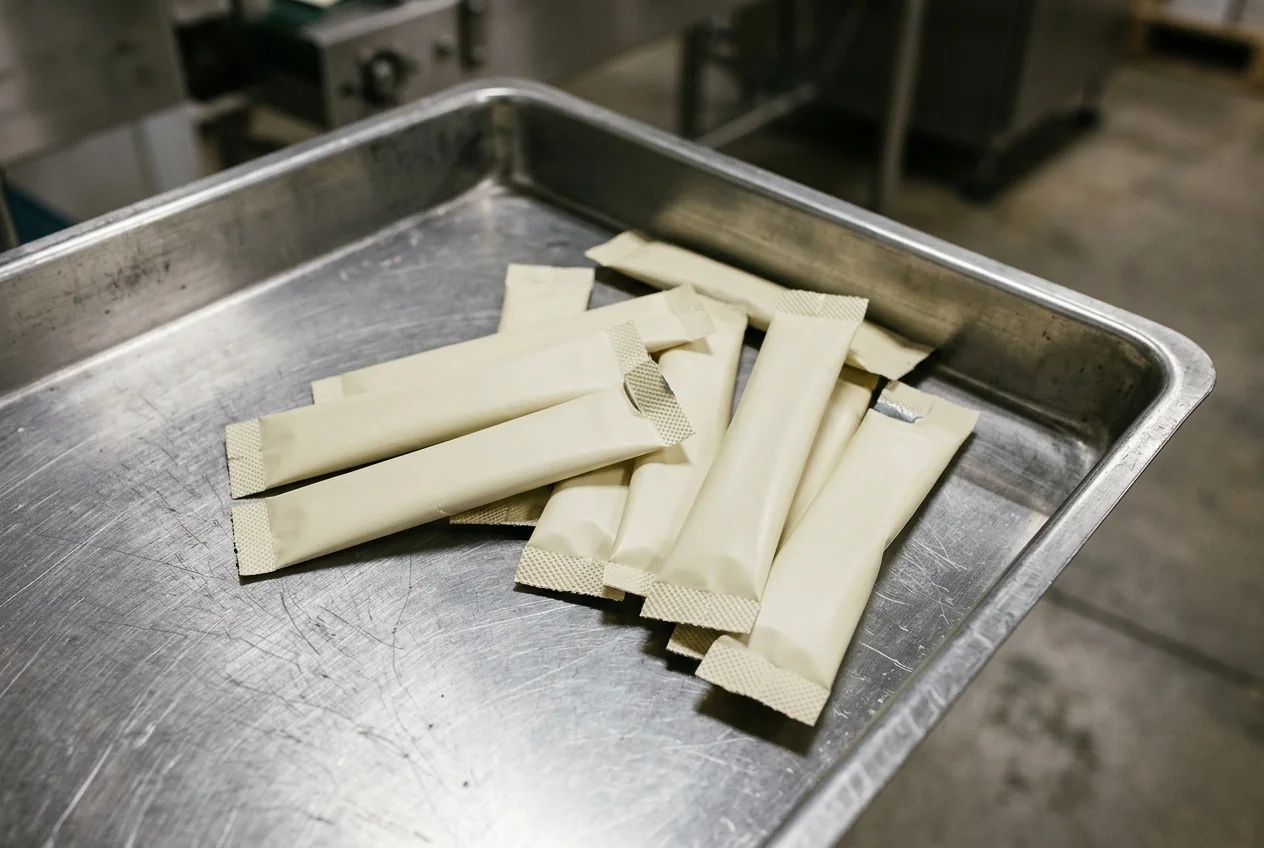
For contract packaging, the useful machine specification is the set of product-and-pack combinations it can demonstrate, together with the work required between them. Define the client’s recipe revision, film, dose and accepted pack, then identify the matching contact set and downstream count. This guide proposes a qualification record rather than claiming a factory capability or catalogue output.
Qualify product families through the dose
Start with the behaviour of the product to be filled. Viking Masek’s stick-pack explanation describes product-dependent dosing apparatus, including volumetric, pump and auger approaches. Omag’s published liquid-collagen discussion identifies viscosity, fill volume, lane count, pack dimensions and material as application inputs. Neither source establishes that one setup suits every formulation.
| Input or item | Value or source | Why it matters |
|---|---|---|
| Client product revision | Approved specification and sample | Connects the pilot to a reproducible formulation |
| Product behaviour | Client data plus trial observations | Guides dosing and product-delivery assessment |
| Dose and limits | Client-approved requirement | Defines acceptance per stick |
| Film and pack construction | Converter specification and sample roll | Defines forming and sealing inputs |
| Contact-part requirements | Approved process and equipment records | Defines readiness between products |
| Secondary pack | Required count and presentation | Defines discharge and reconciliation work |
Keep liquid and powder qualification distinct even when the finished stick looks similar. A shared outer format does not establish common product-contact or cleanout requirements.
Describe lanes without treating them as accepted output
In the retrieved machine explanation, one web is slit into strips that feed individual forming lanes. Product is dosed into formed packs, seals are made and completed sticks discharge. That physical relationship explains why a machine cycle and a finished stick are different counting units.
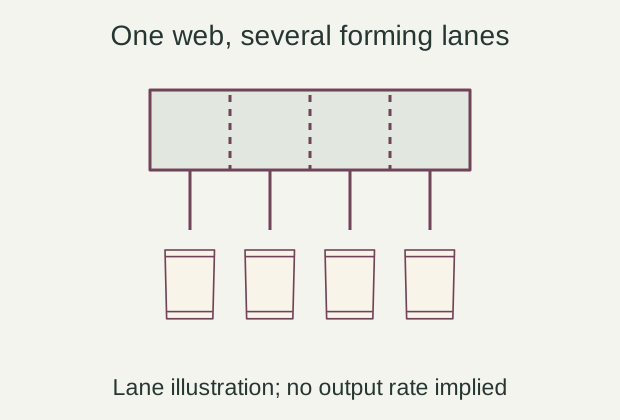
If the proposed machine has multiple active lanes, ask how each lane’s dose and seals will be checked. A total discharge count can conceal a lane-specific defect. Record disabled lanes and startup scrap so a pilot’s result cannot be confused with the maximum configured lane count.
Avoid building the order promise from a quoted maximum rate alone. Agree an observation window with representative product and film, and count the accepted sticks within it. Describe interruptions and held output separately.
Map each client order to a configuration
Use a capability matrix that names the evidence rather than a general “powders” or “liquids” tick. It should make an unqualified combination visible to the planner.
| Client / SKU revision | Dosing and contact set | Film / pack | Pilot evidence | Changeover dependency | Status |
|---|---|---|---|---|---|
| ___ | ___ | ___ | ___ | ___ | Qualified / hold |
| ___ | ___ | ___ | ___ | ___ | Qualified / hold |
| ___ | ___ | ___ | ___ | ___ | Qualified / hold |
A family grouping can simplify planning where the responsible team approves it. Keep the basis for grouping and the boundary that triggers another trial. A new film construction, different dose behaviour or changed seal requirement should receive an explicit decision rather than inheriting a prior result without review.
Include batch closeout in the pilot
A production cell must do more than produce loose sticks. The client may require a counted secondary pack, specific coding and a retained sample. Include those steps in the qualification scope so the planner knows what the demonstrated output represents.
| Pilot handoff | Record to retain | Decision owner |
|---|---|---|
| Before start | Product, film and specification identities | Production / client approval as assigned |
| At restart | Recipe/contact set and first-off acceptance | Authorized process owner |
| During run | Lane observations, stops and reject reasons | Production with quality checks |
| At closeout | Accepted, held and discarded quantities | Batch reconciliation owner |
| Into next order | Material return and clearance references | Assigned turnover owner |
Separate a successful mechanical demonstration from permission to ship. The client’s release rules and any applicable quality procedures remain outside this editorial checklist.
Use the pilot result in planning and cost
Transfer accepted output, observed work and material consumption into the order model. The cost-per-stick worksheet keeps that denominator and the setup costs explicit. Use the batch handoff guide when multiple clients share product-contact equipment and responsibility changes between shifts.
Methods and sources
The process description uses Viking Masek’s 26 April 2018 stick-pack guide, read with full-text local archive sources. Omag’s 4 August 2026 article supplies an application-specific example of formulation and configuration inputs. We do not transfer either manufacturer’s capability to this publication or to an unspecified copacker. Tables are editorial records, and images depict generic materials. Sources were retrieved on 16 October 2026. Continue with contract packaging equipment.
Source documents read:
- How do Stick Pack Machines Work? (retrieved 16 October 2026).
- Liquid collagen in stick-pack (retrieved 16 October 2026).