
Costing only the time when sticks are leaving the machine understates a short order’s work. Divide the batch costs you choose to include by accepted sticks, and retain setup, changeovers and discarded or held output as separate inputs.
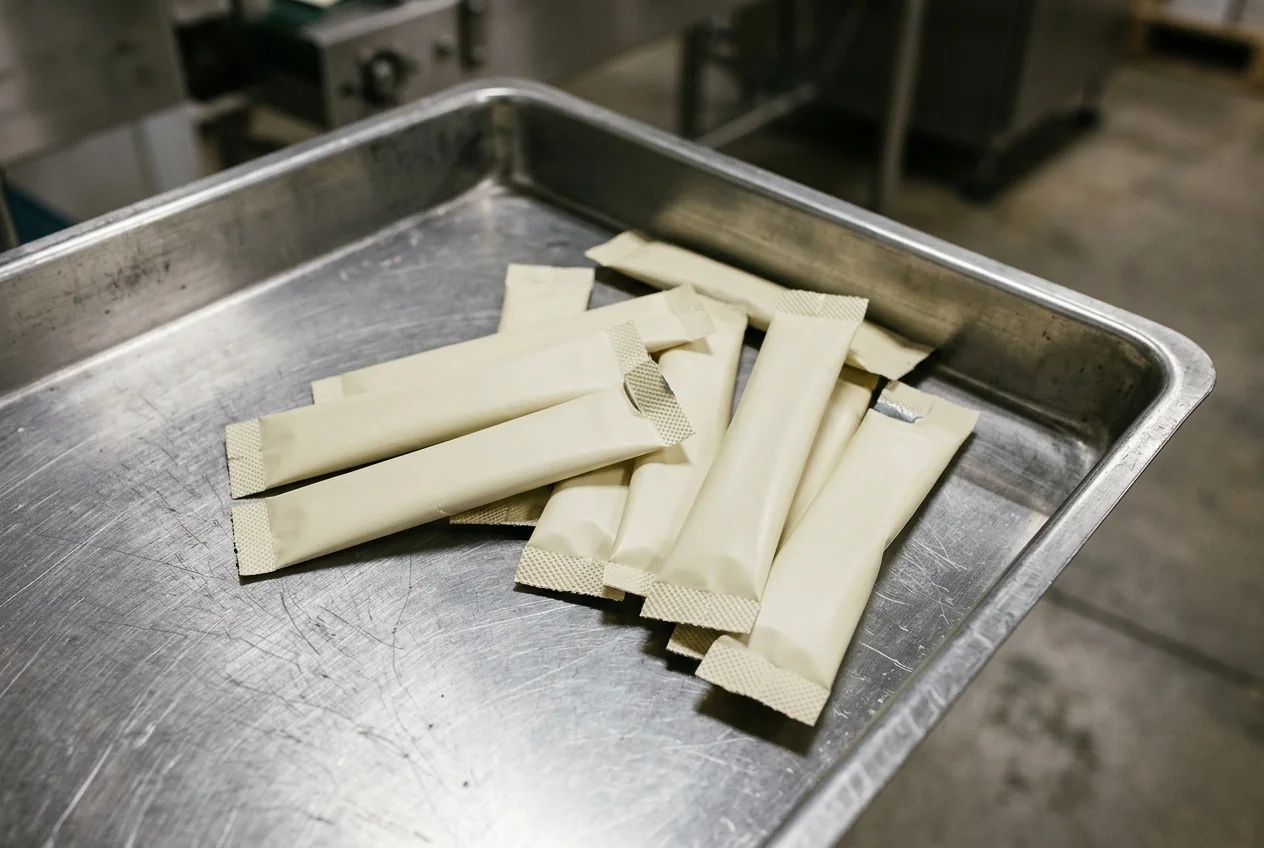
Cost per stick pack is a defined accounting boundary, not a universal market rate. For a production review, use actual accepted sticks and recorded batch consumption. For a future order, label each quantity and cost as an estimate with its basis. The blank worksheet below helps a copacker reconcile the two without inserting an unproven machine rate.
Decide which costs the number includes
State whether you are calculating tolling, conversion cost or a fuller order cost including product and packaging. Customer-owned material may have no purchase charge in a tolling invoice while still requiring a quantity and waste record.
| Input or item | Source | Why it matters |
|---|---|---|
| Cost boundary | Agreed finance/order definition | Makes the result comparable |
| Product and film ownership | Client agreement | Distinguishes consumption from an invoice charge |
| Setup and changeover work | Batch labour/resource record | Captures work before accepted output |
| Run costs | Documented labour, resources and consumables | Supplies the numerator once |
| Accepted sticks | Reconciled release record | Supplies the denominator |
| Held or rejected output | Disposition record | Prevents produced output being treated as saleable |
List exclusions alongside the result. A tolling-only cost should not be compared with another proposal that includes film and product as though both described the same service.
Reconcile output before dividing
Viking Masek’s process guide describes multiple forming lanes supplied from one web, with completed sticks discharged downstream. That means cycles, cut events and sticks are not interchangeable units. Use the actual counting record and account for active lanes where the estimate begins with machine cycles.
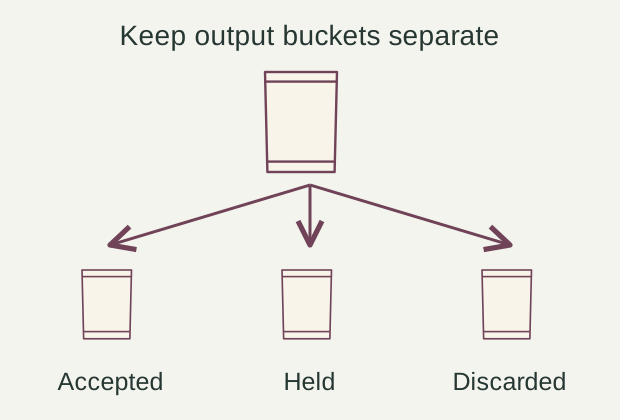
For the same batch boundary, reconcile:
produced sticks = accepted sticks + held sticks + discarded sticks
Define those buckets as mutually exclusive at the time of the review. A held quantity may move into accepted or discarded later; update the record rather than adding it to both. Returned unused film or product belongs in the material reconciliation, not in produced-stick output.
If accepted quantity is zero, unit cost is undefined. Report the incurred batch cost and the reason acceptance failed instead of dividing by planned output.
Keep setup consumption visible
Film used in threading, registration or startup still belongs to the selected order boundary, even if it never becomes an accepted stick. Product retained in the path also needs a recorded disposition. Weigh or count materials using the site’s approved method; this worksheet does not prescribe one.
| Cost line | Actual quantity / time | Unit basis | Cost amount | Included elsewhere? |
|---|---|---|---|---|
| Setup labour or resource allocation | ___ | ___ | ___ | ___ |
| Run labour or resource allocation | ___ | ___ | ___ | ___ |
| Product consumed, if in scope | ___ | ___ | ___ | ___ |
| Film consumed, if in scope | ___ | ___ | ___ | ___ |
| Other consumables and secondary pack | ___ | ___ | ___ | ___ |
| Batch-specific checks or external work | ___ | ___ | ___ | ___ |
| Agreed overhead allocation | ___ | ___ | ___ | ___ |
A loaded machine-hour rate may already include labour, maintenance or overhead. Define its contents before adding those costs separately. The same discipline applies to waste: if material consumption already includes scrapped material, do not add its full material cost again as a separate scrap charge.
Calculate the unit result and explain the gap
Use:
cost per accepted stick = total included batch cost / accepted sticks
For planning, retain the setup component separately:
setup contribution per accepted stick = included setup cost / estimated accepted sticks
That expression explains why order quantity matters without claiming a price break or guaranteed efficiency. If a quote assumes one long campaign but production runs several separate batches, revise the setup count and release workload explicitly.
Compare estimate and actual by input. Was the difference caused by more setup work, a changed material price, lower accepted output or an additional release requirement? Replacing the result with a new blended rate loses that explanation.
Use the blank record
Download the blank batch-cost CSV. It contains input rows, units and formula definitions; it is a blank record, not an automated spreadsheet or a price estimator. Enter actual or estimated amounts consistently and calculate the formulas above in your approved costing tool.
For a machine configuration that has not yet been qualified, begin with the stick-pack production-cell guide before treating a planned lane count as order capacity.
Methods and sources
The cost definitions and blank CSV are original editorial tools. Public stick-pack process descriptions from Viking Masek and Omag establish the production context; neither supplies the prices used by this model. No monetary inputs, market averages, factory rates or payback are asserted. Sources were retrieved on 16 October 2026. Return to contract packaging equipment for qualification and planning records.
Source documents read:
- How do Stick Pack Machines Work? (retrieved 16 October 2026).
- Liquid collagen in stick-pack (retrieved 16 October 2026).